


Description
PrymaLab · Research Use Only
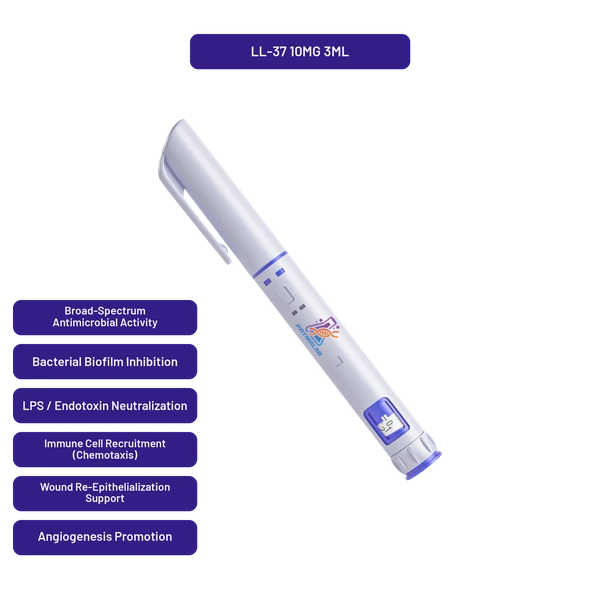
Preloaded Autoinjector | LL-37 | 3ml Pen | 10mg
Human cathelicidin in solution · 3ml at 10/3 mg/ml · No reconstitution step
The LL-37 pen is a preloaded 3ml research autoinjector holding 10mg of the 37-residue human cathelicidin in solution, which puts the concentration at 10/3 mg/ml. What separates this molecule from most peptides in a cartridge is that it carries no oxidation-prone residue at all, so its instability is physical rather than chemical: a cationic amphipathic helix that self-associates and binds surfaces.
Specification Table
| Property | Value |
|---|---|
| Device format | Preloaded autoinjector pen, glass cartridge |
| Fill volume | 3 ml |
| Concentration | 10/3 mg/ml |
| Total compound in device | 10 mg |
| Molar concentration | 10 × 0.0742 mM |
| Compound | LL-37, mature C-terminal peptide of hCAP18 (gene CAMP), residues 134 to 170 of the precursor |
| CAS number | 154947-66-7. Which salt the registry entry denotes is unverified |
| Molecular formula | C205H340N60O53 |
| Molecular weight | 4493.3 g/mol average, 4490.58 Da monoisotopic |
| Amino acid sequence | LLGDFFRKSKEKIGKEFKRIVQRIKDFLRNLVPRTES (37 residues, linear, unmodified) |
| Solution appearance | Clear and colourless, free of visible particulate |
| Reconstitution required | None. Supplied as solution |
| Excipient system | Not published on the product record. Confirm against certificate of analysis |
| Solution pH | Not published on the product record |
| Storage | 2-8°C, protected from light, do not freeze |
| Light sensitivity | Low intrinsically. No Trp, Tyr, His or Met to drive photo-oxidation |
| Solution stability | Not established over device shelf life in published data |
| Net charge at pH 7 | Approximately +6 (11 Lys and Arg against 5 Asp and Glu) |
| Self-association | Strong and concentration, salt and pH dependent. Helix-oligomer equilibrium is live in solution |
| Adsorption risk | High. Cationic amphipathic peptides bind anionic glass and hydrophobic polymer |
| Salt form | Acetate or trifluoroacetate on the research market. Counter-ion in any given device unverified |
| Purity | Per lot-specific certificate of analysis |
| Regulatory status | No approved human or veterinary formulation under FDA, EMA, PMDA, TGA or Health Canada |
What Changes When LL-37 Ships in Solution?
Sealing this cathelicidin into an aqueous fill removes the protection lyophilization provides, and the liability it exposes is the opposite of the usual one, because the peptide has no oxidation hotspot anywhere along its 37 residues.
Read the sequence and the absences are what stand out. LLGDFFRKSKEKIGKEFKRIVQRIKDFLRNLVPRTES contains no cysteine, so there is no disulfide to scramble and no free thiol to oxidise. It contains no methionine, no tryptophan, no tyrosine and no histidine, which between them account for most of the covalent oxidation chemistry that troubles peptide solutions. The only aromatic residues are four phenylalanines, and phenylalanine absorbs below roughly 260 nanometres and is a poor photosensitiser. Deamidation is similarly quiet: there is a single asparagine, Asn30, followed by leucine, which is a slow-deamidating context, and the two aspartates at positions 4 and 26 sit in neither an Asp-Gly nor an Asp-Pro motif.
What remains is physics. Eleven lysine and arginine residues against five aspartate and glutamate give a net charge near +6 and a strongly basic isoelectric point, and the helix that charge decorates is amphipathic: polar face on one side, nonpolar face on the other. In dilute low-salt water the peptide is largely disordered. As concentration, ionic strength, pH or anionic lipid content rise it folds into an amphipathic alpha-helix and oligomerises, and Johansson and colleagues reported in 1998 that antibacterial activity tracks that conformational transition rather than running independently of it. Wang resolved the folded state in lipid micelles in 2008 and found a curved helix-bend-helix rather than a straight rod, with a break near residues 14 to 16.
An LL-37 pen sits squarely in the regime where that equilibrium is most active. Concentration is fixed at fill, the ionic environment is whatever the unpublished excipient system supplies, and the solution then stands at 2-8°C for the life of the device. The oligomeric state of the material drawn on day one and the state drawn eight weeks later are not guaranteed to be the same, and no mass measurement will report the difference, because self-association changes nothing about molecular weight.
Surface adsorption is the second half of the problem. A +6 amphipathic peptide has an electrostatic route onto anionic borosilicate glass and a hydrophobic route onto polymer, and losses of that kind fall hardest on low-strength fills. No quantitative adsorption study of this peptide in a cartridge was located, so the size of the effect is unverified.
There is no reference formulation to argue from either. No approved LL-37 drug product exists in any jurisdiction, so no manufacturer has published the buffer, pH and surfactant choices a stable aqueous presentation would need. Research material ships as the lyophilate and is reconstituted immediately before use, precisely because of the behaviour described above.
What Is Known About LL-37 Solution Stability?
Almost nothing that is specific to a sealed device. No dedicated long-term aqueous stability study and no preloaded-solution formulation study of this peptide was located, which makes LL-37 solution stability an inference from structure rather than a measured quantity.
The inference is at least well grounded. With the covalent liabilities minimal, a standing solution is unlikely to fail by the routes that dominate shelf-life discussions elsewhere: no methionine sulfoxide, no oxidised tryptophan, no rapid asparagine deamidation. Freezing is the one handling step with a clear direction, because it concentrates solutes at the ice front and promotes aggregation.
What a stability protocol would have to measure here is unusual. Identity by mass spectrometry will look reassuring for a long time, because oligomerisation, conformational change and adsorptive loss are all mass-silent. Anyone treating LL-37 solution stability as answered by an intact-mass check is measuring the one thing least likely to have changed. Size-exclusion chromatography, dynamic light scattering and a thioflavin T fluorescence read for amyloid-like assembly answer the actual question, and quantitation against a fresh standard answers the adsorption half of it.
What Does the LL-37 Pen Deliver Per Increment?
Concentration is 10 mg divided by 3 ml, and every downstream figure follows from that one division, so the arithmetic is worth writing out rather than approximating.
Molar concentration is (10/3 divided by 4493.3) multiplied by 1000, which reduces to 10 × 0.0742 mM. Mass delivered per 0.01 ml, the smallest increment most pen mechanisms resolve, is (10/3) × 0.01 mg. Per 0.1 ml it is (10/3) × 0.1 mg. Working an example makes the scale legible: at 10 mg total the fill is 3.333 mg/ml, the molarity is 0.742 mM, one 0.01 ml increment delivers 33.3 micrograms and 0.1 ml delivers 333 micrograms.
Set that against the concentrations at which this peptide does anything in the published assays. Antibacterial and mammalian-cell cytotoxic effects are reported in the low micromolar range, single digits to tens of micromolar. A 0.742 mM fill is 742 micromolar, roughly 30 to 100 times above the range where cytotoxicity and haemolysis are seen in vitro, before any dilution at all. That comparison yields a handling figure rather than a dosing one.
At 4493.3 g/mol this is a heavy peptide, so the molar figure per unit mass is low: the same 10 mg of a 1300 g/mol decapeptide would give roughly 3.5 times the molarity.
What Does the LL-37 Pen Format Suit?
It suits work that needs repeated equivalent draws from one lot and one fixed concentration, and it suits it less well than it would for a peptide whose solution state were stable and known.
The generic case for the format is set out on the pen versus vial comparison and on the preloaded autoinjector category page, and all of it holds here.
The compound-specific qualification is that the variable a preloaded device removes is not the variable that most threatens this peptide. Reconstituting a vial badly introduces volume error and shear. Standing in a cartridge for weeks introduces conformational drift and adsorptive loss, neither of which is visible and neither of which resets. For assays where the oligomeric state of the input matters, and for this peptide that includes most membrane-activity work, a fresh reconstitution from lyophilate remains the more defensible starting material.
Where the LL-37 pen earns its place is consistency of the non-peptide variables: one buffer, one pH, one preparation event. For a peptide this prone to surface losses, removing eight hand transfers is a real reduction in variance even if it does nothing about the aggregation question.
What the Product Record Does Not State
Four fields are absent, and for a cationic amphipathic peptide each of them changes what is in the cartridge.
The excipient system is unpublished. Ionic strength sets the position of the folding and self-association equilibrium directly, so a saline-containing formulation and a low-salt formulation contain measurably different populations of the same peptide. Any surfactant present, if there is one, is doing the work of suppressing surface adsorption and needs naming before an experiment is designed around delivered mass.
Solution pH is unpublished. Charge state, and therefore both the folding equilibrium and the affinity for anionic glass, depend on it.
The counter-ion is unpublished. Trifluoroacetate comes off preparative reversed-phase chromatography as a matter of course and is cytotoxic at concentrations overlapping those used in cell work, so a TFA salt and an acetate salt are not interchangeable inputs.
Fill date and stability over shelf life are unpublished, as is the peptide content net of counter-ion and water. Peptide content matters more than usual here, because a gravimetric fill of a TFA salt at nominal 10 mg contains less peptide than the label suggests. Request all of it from the certificate of analysis before quantitative work, alongside the checks set out on peptide storage and stability.
Verifying an LL-37 Pen and Confirming Its Contents
Inspect the solution against a white background before each draw and expect clear, colourless liquid with no visible particulate, since haze or fine particulate is the one aggregation endpoint the eye can catch.
The standard quantitation shortcut fails on this peptide, and that is worth knowing before someone reaches for a spectrophotometer. Absorbance at 280 nanometres works because tryptophan and tyrosine absorb there. This sequence has neither, so its molar extinction coefficient at 280 nm is effectively zero and an A280 reading on a genuine sample is indistinguishable from an A280 reading on buffer. Quantitation has to move to the peptide bond at 205 to 214 nanometres, to a colourimetric assay, or to amino acid analysis against a standard.
Identity and covalent integrity are the easy part. Intact-mass measurement against 4493.3 g/mol average or 4490.58 Da monoisotopic will confirm the backbone, and reversed-phase chromatography against a fresh reference will resolve the small covalent variants. Neither reports on oligomeric state.
State and quantity are the hard part and the part that matters. Size-exclusion chromatography or dynamic light scattering reports the oligomer distribution, circular dichroism reports helicity against the disordered baseline of dilute low-salt water, and thioflavin T fluorescence reports amyloid-like assembly. Quantifying total peptide against a freshly prepared standard is what catches adsorptive loss, which is otherwise invisible: what remains in solution is intact, there is simply less of it.
Let the LL-37 pen equilibrate to room temperature before actuating, since a cold solution is more viscous and a spring-driven mechanism meters viscous liquid differently.
What Do Claims About LL 37 Peptide Benefits Rest On?
They rest on a large in vitro and animal literature about an endogenous human peptide, and on no controlled human trial of the injected route for any of the uses the market implies.
The molecule itself is well described. Gudmundsson and colleagues characterised the human gene and the processing of the cathelin precursor to the mature 37-residue peptide in granulocytes in 1996, having first reported it as FALL-39 before the mature N-terminus was settled. The name encodes the structure: two leading leucines and 37 residues. It is produced by neutrophils and epithelia and is found in sweat and wound fluid, which is why the peptide is described in humans in enormous detail while remaining unstudied as an administered injectable.
The mechanism is direct rather than receptor-mediated in its primary action. The cationic helix binds and permeabilises anionic microbial membranes, and the same amphipathic character that does that also lyses mammalian cells. Chemotactic activity via FPR2, nucleic-acid binding and effects in angiogenesis models make up the rest of the account.
The adverse side of the file is specific and should not be skipped when LL 37 peptide benefits are being weighed. This peptide is cytotoxic and haemolytic to mammalian cells at low micromolar concentrations. It is pro-inflammatory and appears in the pathophysiology of rosacea and psoriasis. Weber and colleagues reported in 2009 that hCAP18/LL-37 promotes a metastatic phenotype in breast cancer through ErbB2 and MAPK signalling, and Wu and colleagues reviewed in 2010 a cancer role that is context-dependent and includes tumour promotion. A molecule that is double-edged in oncology models does not belong in a benign longevity framing. Further background sits in the cathelicidin research overview.
Half-life in human plasma is not established in the sources checked here, and a substantial fraction of circulating peptide binds lipoproteins and apolipoprotein A-I, which sequesters it. Systemic injectable administration of the native peptide is not an established route in the literature.
Buying LL-37 for Research and the Regulatory Position
This peptide is not an approved drug product under the FDA, EMA, PMDA, TGA or Health Canada, which means anyone searching to buy LL-37 is buying a research reagent and nothing else.
No FDA-approved labelling exists, so there is no reference specification to compare a supplier’s certificate against. Whether this peptide appears on the FDA 503A or 503B bulk drug substance lists for pharmacy compounding was not confirmed in the sources used here and is unverified; absent approval or a listed bulk substance, compounding for injection would be problematic. It does not appear as a named entry on the WADA Prohibited List; the current document was not consulted, so the position is unconfirmed.
Listings advertising LL-37 peptide for sale vary widely in what they disclose, and three fields decide whether a lot is usable: the counter-ion, the peptide content net of salt and water, and the analytical method behind the stated purity. Anyone comparing offers of LL-37 peptide for sale should treat the certificate of analysis, not the listing, as the specification, and researchers who buy LL-37 in a preloaded format have the additional question of the fill date.
No safety profile exists for the injected route because no trial has established one. There is no controlled human trial supporting subcutaneous administration of this peptide for any wellness or performance endpoint, and the cytotoxicity and oncology findings above are the reason that gap reads as a warning rather than as an absence of information.
What Is LL-37 and How Does It Kill Bacteria?
LL-37 is the only human cathelicidin, released from the C-terminal end of the hCAP18 precursor by proteinase 3, and it takes its name from the two leucines that begin it and the 37 amino acids that follow. It is a cationic antimicrobial peptide, an AMP in the shorthand of that literature, with net positive charge from six lysines and five arginines, giving about +6 overall, and hydrophobic residues on one face when it folds into a helix. The cathelicidin family is defined by the conserved cathelin domain in the precursor rather than by the mature sequence, which is why its members differ so much between species. That combination is the whole mechanism.
Bacterial membranes carry a strongly negative outer surface, from lipopolysaccharide in gram-negative organisms and from teichoic acids in gram-positive walls, while mammalian outer leaflets are close to neutral and carry cholesterol. The peptide’s positive charge draws it to the bacterial surface, the helix inserts along the membrane, and above a threshold concentration the bilayer loses integrity. That is a physical mechanism rather than a receptor-mediated one, which is why resistance to it develops slowly and why the reported activity spans gram-positive and gram-negative bacteria, fungi, some enveloped viruses and mycobacterium tuberculosis. E. coli and pseudomonas aeruginosa are the two organisms most often used to demonstrate it.
Two features of that mechanism matter for anyone working with the molecule. Antimicrobial activity falls sharply as ionic strength rises, because salt screens the electrostatic attraction that drives the first step, and in physiological saline the minimum inhibitory concentrations reported in low-salt buffer no longer hold. Serum proteins bind it. And biofilm behaviour is different again: sub-inhibitory concentrations disrupt biofilm formation in several species by interfering with attachment and with quorum signalling, at doses well below those that kill planktonic cells, which is one of the more reproducible findings in the literature.
What Does It Do Besides Kill Things?
More than it does as an antibiotic, arguably. The peptide is a signalling molecule of the innate immune system in its own right, acting through FPR2 and, in epithelial cells, by transactivating EGFR. It is chemotactic for neutrophils, monocytes and T cells, and it induces chemokine release from epithelium, so it recruits the cells that will do the rest of the work. Macrophages respond to it as well.
Its handling of LPS is the effect with the clearest therapeutic logic. The peptide binds that molecule directly and neutralises it, blunting toll-like receptor 4 signalling and reducing the pro-inflammatory cytokines that follow. That is immune modulation in the strict sense: the same molecule that kills the organism also dampens the inflammatory responses to its debris. Defensins, the other major group of human AMPs, overlap with it in tissue distribution but act through different structural mechanisms. Together the two groups carry most of the chemical arm of innate immunity in humans, and innate immunity is where this molecule’s whole physiological role sits.
Wound healing is where those two roles combine and where the clinical interest sits. Wound healing is also the setting in which the peptide’s own expression is highest. The peptide is upregulated in injured skin, and wound healing studies report that it drives re-epithelialization by moving keratinocytes into the wound bed, promotes angiogenesis, and modulates apoptosis in the surrounding tissue. Chronic wounds, particularly diabetic foot ulcers and venous leg ulcers, show reduced levels of it, which is the observation behind the trials. The clinical record is two studies and it is mixed. Gronberg and colleagues (2014) ran a phase one and two study in 34 patients with venous leg ulcers at 0.5, 1.6 and 3.2 mg per ml, and found the healing rate roughly sixfold higher than placebo at the lowest dose and threefold at the middle one, with no improvement and more local reactions at the highest. The larger phase two b trial that followed, in 148 patients across Poland and Sweden at the two lower doses over thirteen weeks, missed its primary endpoint: wound closure was around 25 per cent in every arm, with benefit only in a post-hoc subgroup of ulcers of 10 square centimetres or more. Wound healing remains the most advanced clinical application of this molecule and it has not yet produced a positive confirmatory trial. Tissue repair claims that go beyond skin are extrapolation.
What Should Be Understood Before Working With It?
The mouse orthologue is called CRAMP, cathelin-related antimicrobial peptide, and it is not the same sequence. It is 34 residues, differs substantially in composition, and mouse data therefore transfers less cleanly than the shared function suggests. Papers using it are reporting on a related molecule, not on this one, and the distinction is often lost in secondary summaries.
Proteolytic degradation is the practical limit. As a linear all-L peptide it is a substrate for the proteases present in wound fluid and in serum, which is why topical formulations dominate the clinical work and why systemic administration has not progressed. Cytotoxicity is the other limit, and where it starts depends on the assay and the cell type: frank cytotoxicity is commonly reported from about 5 to 25 micromolar, DNA fragmentation in human vascular smooth muscle cells has been shown at 6 micromolar, and haemolysis is measurable below 10 micromolar in some systems. The membrane mechanism that lyses bacteria does not stop at the bacterial membrane. Side effects in the topical trials were local, and no systemic safety database exists because no systemic trial has been completed.
On the certificate, ask for purity by HPLC with the gradient described and an accurate mass, and note that a 37-residue synthesis carries a real risk of deletion sequences that a fast gradient will not resolve. Endotoxin matters here more than for most peptides, since the molecule binds LPS and a contaminated preparation confounds every immunological readout taken from it. Thymosin alpha-1, which is frequently listed alongside this compound as an immune option, is a 28-residue acetylated peptide with an approved product behind it in more than thirty countries, though not in the United States or European Union, and no antimicrobial activity of this kind at all.
Published Literature
Each entry below was checked against a primary index before inclusion. All five concern the compound; nothing has been published on this delivery format.
- Gudmundsson GH, Agerberth B, Odeberg J, et al. The human gene FALL39 and processing of the cathelin precursor to the antibacterial peptide LL-37 in granulocytes. Eur J Biochem. 1996;238(2):325-332. DOI: 10.1111/j.1432-1033.1996.0325z.x PMID: 8681941
- Johansson J, Gudmundsson GH, Rottenberg ME, et al. Conformation-dependent antibacterial activity of the naturally occurring human peptide LL-37. J Biol Chem. 1998;273(6):3718-3724. DOI: 10.1074/jbc.273.6.3718 PMID: 9452503
- Wang G. Structures of human host defense cathelicidin LL-37 and its smallest antimicrobial peptide KR-12 in lipid micelles. J Biol Chem. 2008;283(47):32637-32643. DOI: 10.1074/jbc.M805533200 PMID: 18818205
- Weber G, Chamorro CI, Granath F, et al. Human antimicrobial protein hCAP18/LL-37 promotes a metastatic phenotype in breast cancer. Breast Cancer Res. 2009;11(1):R6. DOI: 10.1186/bcr2221 PMID: 19183447
- Wu WKK, Wang G, Coffelt SB, et al. Emerging roles of the host defense peptide LL-37 in human cancer and its potential therapeutic applications. Int J Cancer. 2010;127(8):1741-1747. DOI: 10.1002/ijc.25489 PMID: 20521250
Frequently Asked Questions
What is the LL-37 pen?
A preloaded 3ml research autoinjector holding 10mg of the 37-residue human cathelicidin in solution at 10/3 mg/ml, with no reconstitution step. It is supplied strictly for laboratory research. No approved human or veterinary formulation of this peptide exists in any jurisdiction.
Why is this peptide’s solution chemistry described as physical rather than oxidative?
Because the sequence contains no cysteine, methionine, tryptophan, tyrosine or histidine, the residues responsible for most oxidative degradation are simply absent. What remains is a cationic amphipathic helix that folds, self-associates and binds surfaces, so the changes that occur in a cartridge are conformational and adsorptive rather than covalent.
What is known about LL-37 solution stability in a sealed device?
No dedicated long-term aqueous stability study or preloaded-solution formulation study was located, so LL-37 solution stability here is inferred from structure rather than measured. The covalent routes are quiet; the open questions are oligomeric state and adsorptive loss, and both are invisible to a mass check.
Does the pen concentration matter for self-association?
Yes, directly. This peptide is largely disordered in dilute low-salt water and becomes helical and oligomeric as concentration, ionic strength and pH rise. A cartridge fixes concentration at manufacture, so the position of that equilibrium is set at fill and cannot be adjusted afterwards without dilution.
What does one 0.01 ml increment deliver?
(10/3) multiplied by 0.01 mg. At a 10 mg total fill that is 33.3 micrograms per 0.01 ml and 333 micrograms per 0.1 ml, from a solution of 3.333 mg/ml and 0.742 mM. Substitute the actual strength once the client fills the placeholder.
How does the fill concentration compare with concentrations used in published assays?
It is far above them. Antibacterial and cytotoxic effects are reported in the low micromolar range, single digits to tens of micromolar. A 0.742 mM fill is 742 micromolar, roughly 30 to 100 times higher, which is a handling observation about undiluted device contents rather than a dosing figure.
Can absorbance at 280 nm be used to check the contents?
No. Absorbance at 280 nanometres depends on tryptophan and tyrosine, and this sequence contains neither, so its extinction coefficient there is effectively zero. Quantitation must use the peptide bond at 205 to 214 nanometres, a colourimetric assay, or amino acid analysis against a standard.
Which measurements would confirm the device contents are intact?
Intact mass against 4493.3 g/mol average confirms the backbone, and reversed-phase chromatography resolves covalent variants. Neither reports oligomeric state, so add size-exclusion chromatography or dynamic light scattering, circular dichroism for helicity, and thioflavin T fluorescence if amyloid-like assembly is a concern.
How would adsorptive loss show up?
As a quiet shortfall in delivered mass with no change in identity. A +6 amphipathic peptide binds anionic glass electrostatically and polymer through its nonpolar face. The peptide left in solution is perfectly intact, there is simply less of it, so only quantitation against a fresh standard catches it.
How light-sensitive is this peptide?
Less than most. Photo-oxidation of peptides runs largely through tryptophan, tyrosine, histidine and methionine, and none of those is present. The four phenylalanines absorb below roughly 260 nanometres and sensitise poorly. Protection from light remains prudent practice rather than the leading degradation route here.
Is a pen or a vial the better starting material for membrane-activity work?
A fresh reconstitution from lyophilate, on current evidence. Activity in the published work tracks the folding and self-association state, and a solution standing for weeks has an oligomer distribution nobody has characterised. The device wins on preparation consistency, not on the state of the peptide itself.
What is not stated on the product record?
The excipient system, the solution pH, the counter-ion, the fill date and the peptide content net of salt and water. Ionic strength sets the self-association equilibrium and the counter-ion decides whether residual trifluoroacetate enters a cell assay, so all five belong on the certificate of analysis.
Why does the counter-ion matter so much here?
Trifluoroacetate comes off preparative reversed-phase chromatography by default and is itself cytotoxic at concentrations overlapping those used in cell work. An acetate salt and a TFA salt are therefore not interchangeable inputs. A gravimetric fill of a TFA salt also contains less peptide than the nominal milligram figure implies.
What do claims about LL 37 peptide benefits actually rest on?
An extensive in vitro and animal literature on an endogenous human peptide, plus early local and topical work. There is no controlled human trial of injected LL-37 for any wellness or performance endpoint, so discussion of LL 37 peptide benefits from a self-injected preparation has no controlled human evidence behind it.
What adverse findings are on the record?
Cytotoxicity and haemolysis against mammalian cells at low micromolar concentrations, pro-inflammatory activity implicated in rosacea and psoriasis, and a double-edged oncology profile: Weber 2009 reported promotion of a metastatic phenotype in breast cancer models and Wu 2010 reviewed a context-dependent cancer role including tumour promotion.
Where can researchers buy LL-37, and what should be checked first?
Only from suppliers selling it as a research reagent, since it is not an approved drug anywhere. Anyone about to buy LL-37 should ask for the counter-ion, the peptide content net of salt, the analytical method behind the purity figure and the fill date before comparing prices.
What separates a usable listing of LL-37 peptide for sale from a poor one?
Disclosure. A listing of LL-37 peptide for sale that states purity without stating peptide content is answering a different question from the one an experiment asks. Treat the lot-specific certificate of analysis as the specification and the listing text as marketing copy.
What is the regulatory position?
Not approved under the FDA, EMA, PMDA, TGA or Health Canada. No FDA-approved labelling exists. Presence on the FDA 503A or 503B bulk drug substance lists was not confirmed here and is unverified, as is status against the current WADA Prohibited List.
What is LL-37?
The only human cathelicidin, released from the hCAP18 precursor by proteinase 3, named for two leucines followed by 37 amino acids. It is a cationic antimicrobial peptide with net positive charge from six lysines and five arginines, about +6 overall, and a hydrophobic face when helical.
How does it kill bacteria?
Physically. Bacterial membranes carry a negative outer surface from lipopolysaccharide or teichoic acids while mammalian outer leaflets are near neutral, so charge draws the peptide in, the helix inserts, and the bilayer loses integrity above a threshold. That covers gram-positive and gram-negative bacteria, fungi, some enveloped viruses and mycobacterium tuberculosis, with E. coli and pseudomonas aeruginosa the usual demonstration organisms.
Why do reported potencies vary so much between papers?
Because antimicrobial activity falls sharply with ionic strength: salt screens the electrostatic attraction driving the first step, so minimum inhibitory concentrations from low-salt buffer do not hold in physiological saline, and serum proteins bind the peptide. Biofilm effects are different again, appearing at sub-inhibitory concentrations well below those that kill planktonic cells.
What are its immune functions?
It signals through FPR2 and, in epithelial cells, by transactivating EGFR. It is chemotactic for neutrophils, monocytes and T cells, induces chemokine release from keratinocytes, and activates macrophages. It also binds endotoxin directly, blunting toll-like receptor 4 signalling and the pro-inflammatory cytokines that follow, which is immune modulation in the strict sense.
What is the evidence in wound healing?
The peptide is upregulated in injured skin and drives re-epithelialization by moving keratinocytes into the wound bed, promotes angiogenesis and modulates apoptosis nearby. Chronic wounds show reduced levels of it. A phase one and two study in 34 patients with venous leg ulcers found the best healing at the lowest of three doses, with none at the highest; the larger phase two b trial in 148 patients then missed its primary endpoint at around 25 per cent closure in every arm. Tissue repair claims beyond skin are extrapolation.
Does mouse data apply directly?
Less than the shared function suggests. The mouse orthologue CRAMP is 34 residues and differs substantially in composition, so papers using it describe a related molecule rather than this one. Proteolytic degradation also limits the human peptide, which is why topical formulations dominate the clinical work.
Compliance Statement
The LL-37 pen is sold exclusively for laboratory research use. It is not a drug, food, or cosmetic product, and it is not a dietary product of any kind. It is not approved by the FDA or any comparable authority for human or veterinary use. This product is not intended to diagnose, treat, cure, or prevent any disease. It must not be given to humans or animals. Purchase is restricted to qualified researchers and institutions operating within applicable laws. All handling is the responsibility of the purchasing laboratory.











Reviews
There are no reviews yet.